Every symbol in Luminaire comes from somewhere. Here you read where. You see what is known about it as fact, and what a tradition sees in it.
FactAnatomy, history and mathematics. You can check them.
TraditionWhat a tradition sees in it and how it explains it.
QuestionWhat you do with it yourself. That is up to you.
Heritage
Zoroastrianism: the origin of Luminaire
Zoroastrianism is the heritage of Hamid Zahedi and the origin of the Luminaire brand. The mark comes from this source. So do the language of light and the emphasis on what you do yourself.
Its best-known maxim fits in three words of Avestan. That is the old language of the Zoroastrian texts.
Humata
Good thoughts
What you let into your mind and where your attention goes.
Hukhta
Good words
How you speak, also when nobody holds you to it.
Hvarshta
Good deeds
What you end up doing, in small things and in large ones.
An old, living religion
It arose in ancient Iran and goes back to the prophet Zarathushtra (Zoroaster). Scholars disagree on his dates. Estimates range from the second millennium to the 6th century BCE. The tradition lives on in communities in Iran and India, among other places. India is home to the Parsis.
The Avesta
The sacred texts are together called the Avesta. Its oldest part includes the Gathas. Tradition attributes them to Zarathushtra himself. Some scholars doubt this.
Ahura Mazda and asha
Ahura Mazda is the Wise Lord. Asha stands for truth and right order. Each person chooses whether to act by it.
Fire as a symbol
Fire stands for truth and light. Zoroastrians pray in the presence of fire, among other places in temples where they keep it burning. They do not worship the fire, they say themselves. They do revere it.
From Faravahar to mark
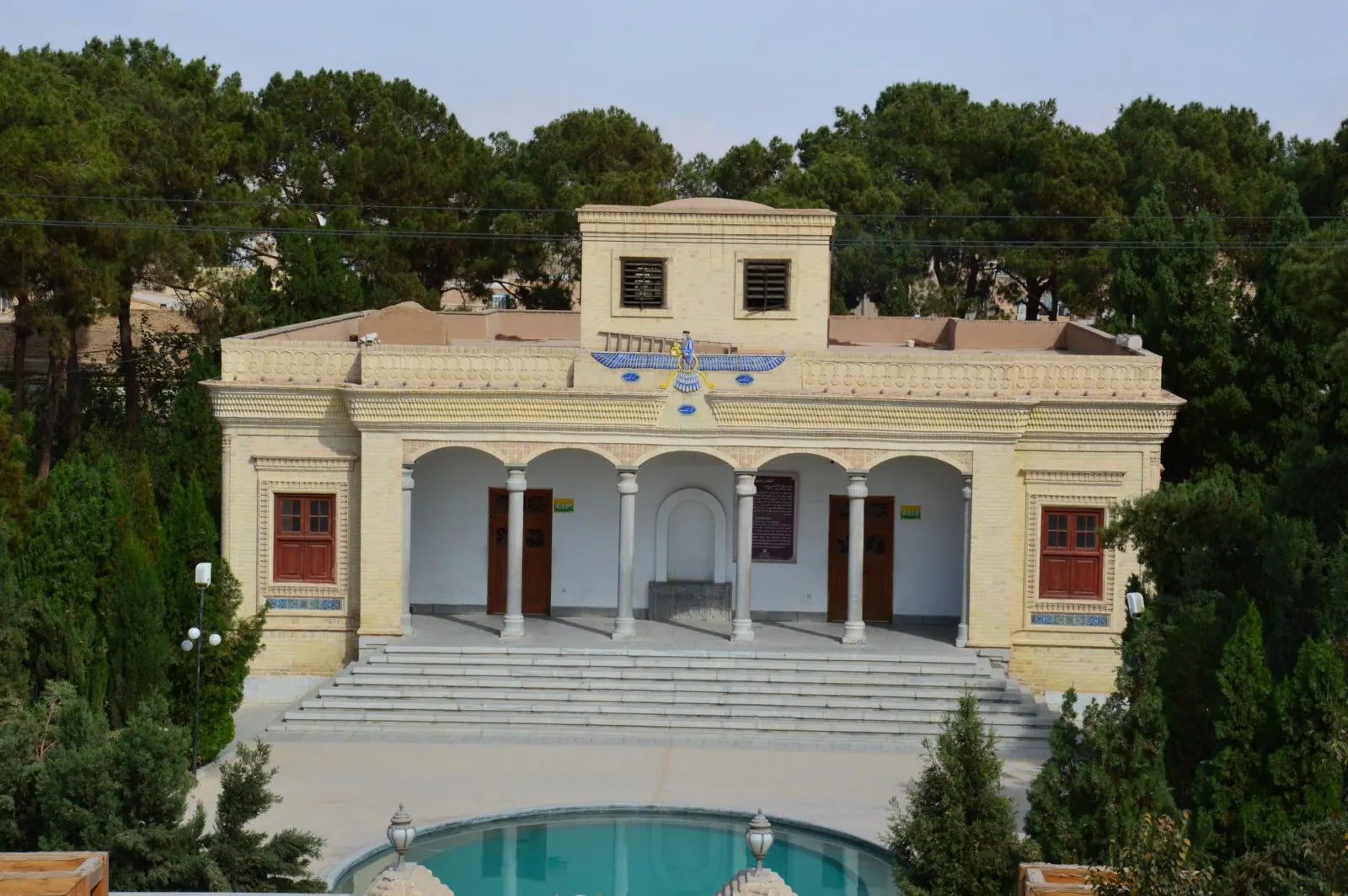
The Faravahar is one of the best-known symbols of Zoroastrianism. Its form goes back to the winged disc of the ancient Near East. You see it in the Achaemenid art of Persia. What the symbol meant there is disputed. Scholars suggest Ahura Mazda or royal glory (khvarenah), among others. Later Zoroastrian interpretation, especially among the Parsis, links it to the fravashi. That is the higher soul of a person, which exists before birth. A common modern reading sees good thoughts, words and deeds in its three rows of feathers.
Luminaire is a coaching brand and not a religious organisation. We do not speak for the Zoroastrian community.
Inspired by Zoroastrianism
Faravahar. A religious symbol, shown here for explanation only.
Driven by evolution
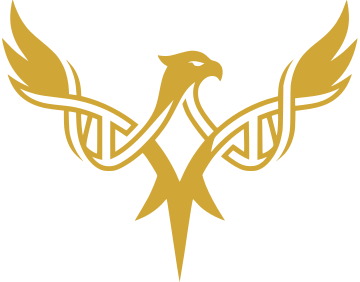
Double helix, the shape of DNA.
Anatomy and symbol
The pineal gland and the third eye
These two are often mixed up. First you read what is in your head. Then what traditions see in it.
LightLight enters the eye and reaches the retina.
Biological clockThe signal reaches the suprachiasmatic nucleus, a small nucleus in the hypothalamus that keeps the day-night rhythm.
Pineal glandBy a detour through the spinal cord and a nerve ganglion in the neck, the signal reaches the pineal gland, which produces the hormone melatonin mainly in the dark.
AnatomySymbolism
Fact
A small endocrine gland
The pineal gland sits in the middle of the brain. It is about the size of a grain of rice, some 5 to 9 millimetres long. It produces melatonin, a hormone the body makes mainly in the dark. So its production follows the change of day and night.
Tradition
An image with its own history
The third eye comes from spiritual traditions. In Indian traditions it belongs to the ajna chakra, on the forehead between the eyebrows. The link with the pineal gland is far more recent. In the 17th century René Descartes called the gland the principal seat of the soul. In the 19th century theosophical writers connected it with the third eye.
Question
What we do with it
We use the third eye as an image for attention: what am I looking at, and what do I not see yet?
Sacred geometry
Shapes people have drawn for centuries
The mathematics is fixed. The meaning comes from people. Both are worthwhile, as long as you keep them apart.
Mathematics and tradition
Vesica piscis
Two equal circles, each through the other's centre. The almond shape between them recurs in medieval church art.
Mathematics and tradition
Flower of Life
Equal circles crossing at fixed distances. The pattern occurs in old decoration. The name dates from the 20th century.
Mathematics and tradition
Golden ratio
A proportion of about 1.618, exactly defined in mathematics.
Mathematics and tradition
Platonic solids
The five regular convex polyhedra. In the Timaeus, Plato linked four to the elements and the fifth to the cosmos. Here you see the icosahedron, with twenty equal triangles.
Symbols
The images you see on this site
Where they come from, in a few lines.
Lotus
Grows from mud and flowers above the water. In Hindu and Buddhist art the lotus stands for purity and unfolding.
Spiral
A very old motif. You find it, among other places, in the Neolithic carvings of Newgrange in Ireland.
Lemniscate
The sign for infinity. John Wallis used it in mathematics in 1655. Later it also gained a spiritual reading.
Eye
From the Egyptian eye of Horus to the third eye. Many cultures link the eye with perceiving and guarding, each in their own way.
Fire
In the Zoroastrian tradition a sign of truth and light. In Luminaire's imagery it is the source of the light.
Double helix
The shape of DNA, described in 1953. In the Luminaire mark it stands for evolution.
A question first?
Choose one image that brings something up. Explore what it means to you, or ask us your question.